
Nuclear Medicine Imaging
Scintillators are crucial in nuclear medicine imaging, efficiently detecting radiation and generating clear images, aiding precise diagnosis. Positron Emission Tomography (PET) is a typical application, particularly with BGO and LYSO, the former offers high detection efficiency, while the latter has a fast response. These properties enhance the clarity of lesion imaging, improving the accuracy of treatment plans and safeguarding human health.
Scintillation crystals serve as the core detection material in nuclear medicine imaging systems, converting gamma-ray signals from radiotracers into visible light pulses that photosensors can process. The performance of the crystal directly determines the image resolution, sensitivity, and timing accuracy of the entire PET or SPECT system.
EBO manufactures scintillation crystals and crystal arrays specifically engineered for nuclear medicine detector applications. Our crystals are supplied to PET/CT equipment manufacturers, medical device research institutions, universities, and crystal integration companies worldwide.
In a PET scanner, a patient is administered a positron-emitting radiotracer. When the positron annihilates with an electron, it produces two 511 keV gamma photons traveling in opposite directions. The scintillation crystal array surrounding the patient intercepts these gamma photons and converts them into visible light signals, which are then detected by coupled photodetectors such as SiPM or PMT. The timing and positional data from coincident detection events are used to reconstruct a three-dimensional metabolic image of the tissue.
The crystal's light output, decay time, density, and energy resolution are all critical parameters that affect how precisely the system can reconstruct the image.
LYSO (Lu2SiO5:Ce) is the most widely used crystal in modern PET scanners. It offers high density (7.1 g/cm3), high light output, and a very fast decay time of approximately 40 ns, enabling accurate coincidence timing for high-sensitivity PET imaging. LYSO crystal arrays are used in both clinical whole-body PET/CT systems and compact research PET instruments.
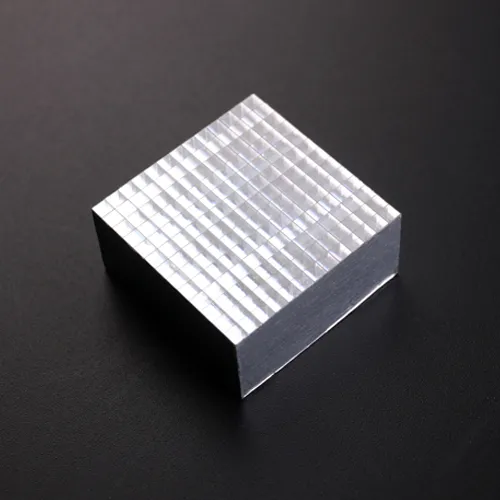
BGO (Bi4Ge3O12) was the dominant PET crystal material for decades. Its very high density (7.13 g/cm3) and high atomic number give it excellent gamma-ray stopping power and a strong photoelectric fraction, resulting in superior energy resolution at 511 keV. BGO remains a preferred choice where detection efficiency is prioritized over timing resolution.
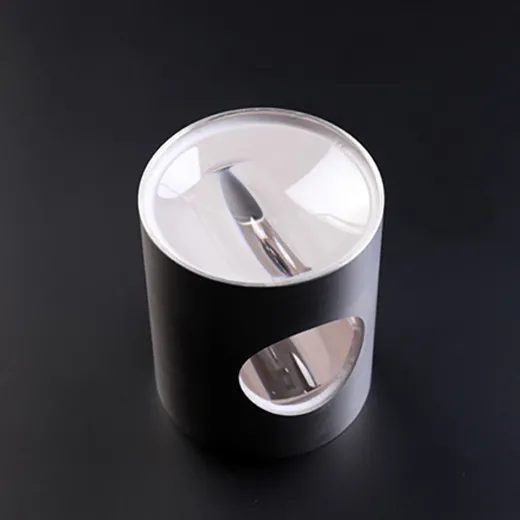
GAGG (Gd3Al2Ga3O12:Ce) is gaining adoption in next-generation PET and SPECT detectors due to its high photon yield and non-hygroscopic nature, making it suitable for compact and portable nuclear medicine devices.
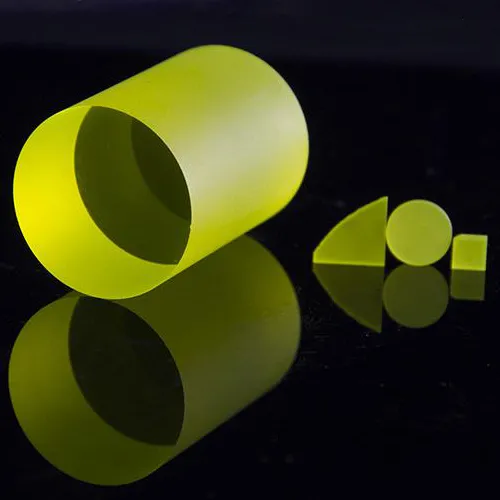
LaBr3 and CZT are applied in SPECT systems and specialized nuclear medicine instruments where superior energy resolution is required for isotope identification.
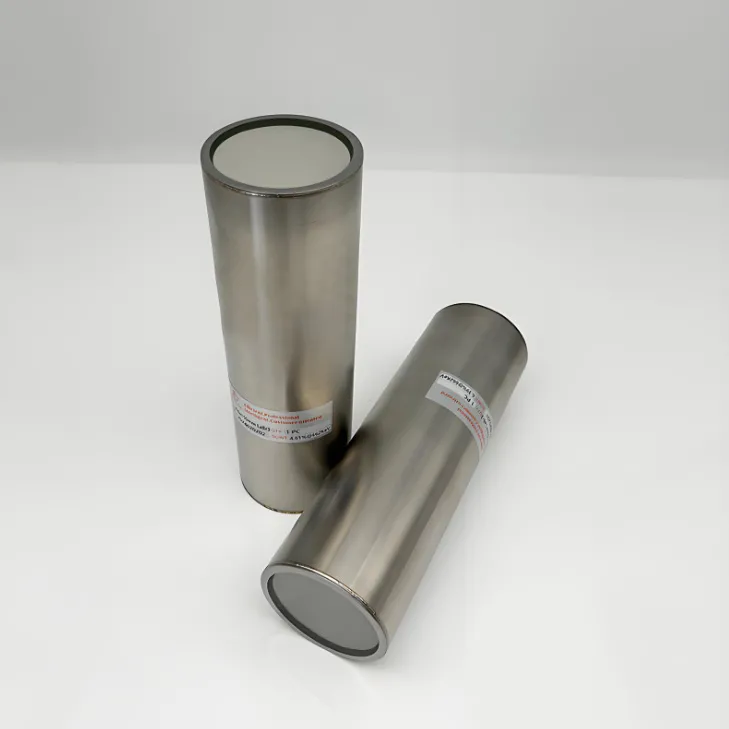
EBO provides fully customized scintillation crystal arrays for integration into PET detector modules. Customization options include:
Pixel size: from 1.0 mm x 1.0 mm up to 6.0 mm x 6.0 mm, supporting both high-resolution research PET and clinical whole-body PET designs
Array dimensions: 1D linear arrays and 2D pixelated matrices, configured to match your detector module layout
Reflector material: BaSO4, ESR film, or E20 reflective film, selected based on light collection efficiency requirements
Crystal material selection: LYSO, BGO, GAGG, or combinations depending on application requirements
Surface finish and coating: customized to optimize optical coupling with SiPM or PMT
All crystal arrays are fabricated with tight dimensional tolerances and consistent optical uniformity to meet the performance requirements of clinical-grade detector systems.
EBO supplies to PET/CT equipment OEM manufacturers integrating crystal arrays into detector rings, medical device research institutes developing new imaging modalities, universities and national laboratories conducting nuclear medicine research, and crystal component distributors and trading companies serving the medical imaging supply chain.
Contact EBO to discuss specifications, request samples, or obtain a custom quotation for your nuclear medicine detector project.

Related Products

Advantage:
High light outputs
Best energy resolution
Fast emission
Excellent radiation hardness
Fast decay times

Advantage:
Excellent Energy Resolution
High Charge Collection Efficiency
High Speed Detection
Direct Conversion – True Semiconductor
High Density and Effective Z

Advantage:
Excellent energy resolution
Dual detection capability
Fast response time
High light yield

Advantage:
High transparency
Excellent durability
Good resistance to vibration, impact, and humidity
Latest Application


